
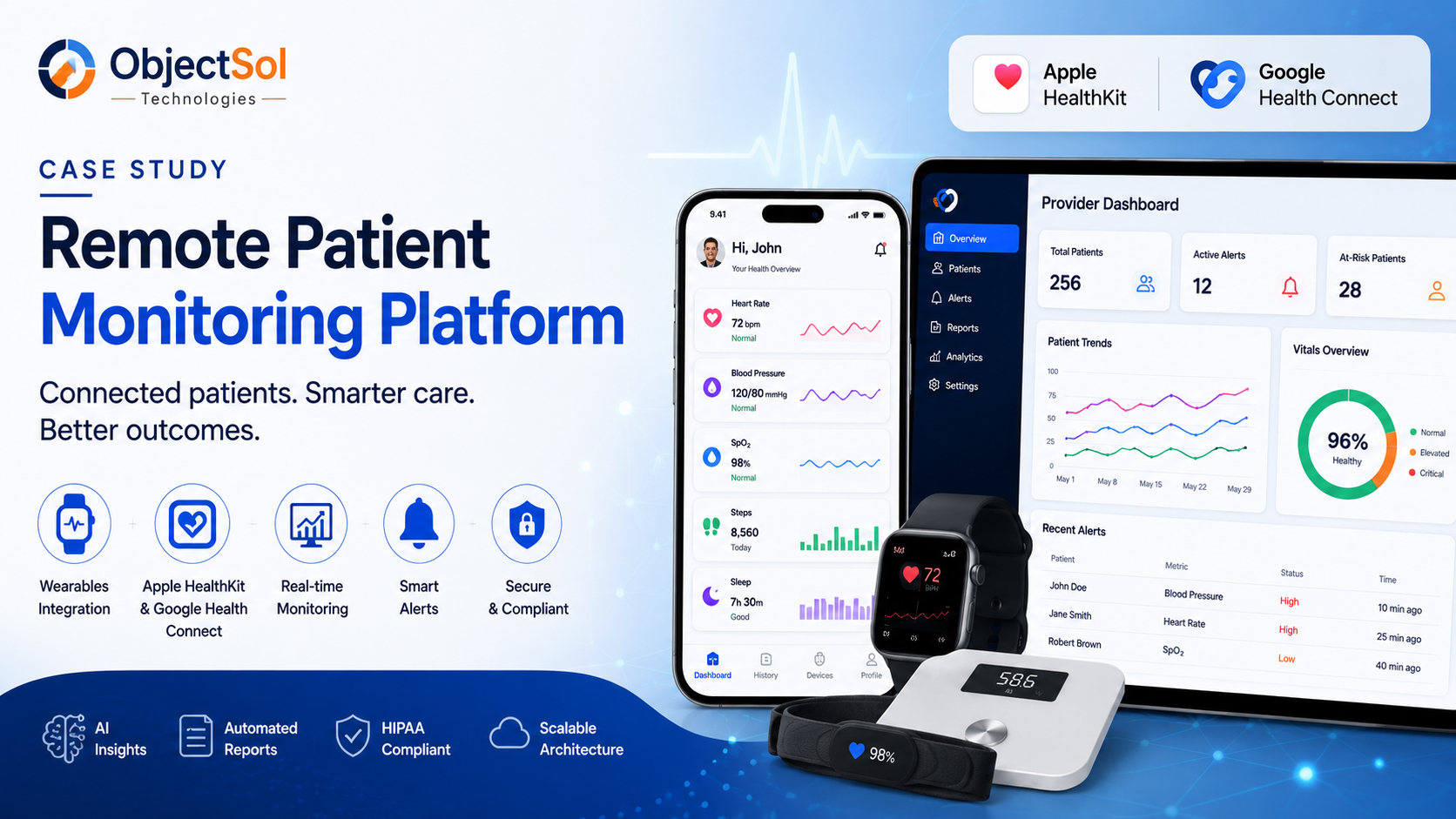
From Fragmented Health Data to Continuous Patient Monitoring
Healthcare is rapidly moving beyond hospital walls.
Patients increasingly expect care to happen wherever they are : at home, at work, or on the move.
At the same time, healthcare providers are facing growing challenges:
- Rising chronic disease populations
- Increasing healthcare costs
- Staff shortages
- Limited visibility into patient health between visits
This is where Remote Patient Monitoring (RPM) is transforming healthcare.
At ObjectSol Technologies, we recently helped build a Remote Patient Monitoring platform that connected patients, clinicians, wearable devices, and mobile health ecosystems into one unified healthcare experience.
From Fragmented Health Data to Continuous Patient Monitoring
The platform integrates:
- Smart Wearables
- Apple HealthKit
- Google Health Connect
- Bluetooth Medical Devices
- Provider Dashboards
- Patient Mobile Apps
- AI-Powered Health Insights
- Clinical Alerting Systems
The result?
A scalable RPM ecosystem capable of continuously monitoring patients while reducing provider workload and improving patient engagement.
The Challenge
Our client wanted to create a next-generation RPM platform that could:
Patient Side
- Track vital signs automatically
- Connect with wearable devices
- Support Apple Watch and Wear OS
- Aggregate health data from multiple sources
- Provide medication reminders
- Deliver personalized health insights
Provider Side
- Monitor hundreds of patients simultaneously
- Identify at-risk patients early
- Receive real-time alerts
- Track patient adherence
- Improve care coordination
Business Side
- HIPAA-ready architecture
- Cloud scalability
- Multi-tenant support
- Future AI integration
- Faster onboarding
The biggest challenge wasn’t building dashboards.
The real challenge was creating a unified health data ecosystem.
The Problem with Traditional RPM Solutions
Most RPM platforms rely on standalone medical devices.
This creates several issues:
- Low patient engagement
- Hardware distribution challenges
- Manual data collection
- Limited patient coverage
Many patients already own:
- Apple Watches
- Fitbit devices
- Samsung Galaxy Watches
- Garmin wearables
- Oura Rings
- Smart blood pressure monitors
- Smart scales
The question became:
How can we leverage the devices patients already use every day?
Our Solution
We designed a unified RPM architecture centered around wearable interoperability.
Instead of forcing patients to use a single device, the platform supports:
Apple Ecosystem
- Apple Health
- Apple Watch
- Apple HealthKit
HealthKit acts as a centralized repository for health and fitness data from Apple devices and supported applications.
Android Ecosystem
- Google Health Connect
- Samsung Health
- Fitbit
- Wear OS Devices
Health Connect serves as a centralized Android health data platform that securely synchronizes data across health and fitness applications.
Connected Medical Devices
- Blood Pressure Monitors
- Glucose Monitors
- Pulse Oximeters
- Smart Weight Scales
- ECG Devices
Cloud Healthcare Platform
- RPM Dashboard
- Alert Engine
- Care Team Portal
- Patient Engagement Engine
- Analytics Platform
Platform Architecture
Layer 1: Data Collection
Data enters the platform through:
Apple HealthKit
Capturing:
- Heart Rate
- Sleep
- Activity
- Steps
- Workouts
- Blood Oxygen
- Heart Rate Variability
HealthKit enables healthcare applications to access user-authorized health data from Apple devices and connected applications.
Google Health Connect
Capturing:
- Activity Data
- Sleep Data
- Heart Rate
- Blood Pressure
- Oxygen Saturation
- Weight
- Exercise Sessions
Health Connect allows Android applications to securely share and synchronize health information from multiple devices and apps.
Bluetooth Medical Devices
For clinical-grade monitoring:
- RPM Blood Pressure Devices
- Connected Weight Scales
- Glucose Monitoring Devices
- Pulse Oximeters
Layer 2: Data Normalization
One of the hardest challenges in RPM is that every device reports data differently.
For example:
Apple Watch Heart Rate ≠ Fitbit Heart Rate Format
Garmin Sleep Data ≠ Samsung Sleep Data Format
We built a normalization engine that converted all incoming data into standardized clinical measurements.
This ensured clinicians could view consistent information regardless of device type.
Data normalization is a critical requirement when integrating multiple wearable ecosystems into clinical workflows.
Layer 3: Clinical Intelligence
Once data was standardized, we created:
Patient Timelines
Showing:
- Daily trends
- Weekly trends
- Historical health patterns
Risk Scoring
Identifying:
- Elevated blood pressure
- Reduced activity
- Poor sleep patterns
- Weight fluctuations
Alert Engine
Generating alerts when:
- Thresholds exceeded
- Vital signs deteriorated
- Adherence dropped
Mobile Application Features
Patient Dashboard
Patients could view:
- Daily activity
- Sleep trends
- Heart rate
- Blood pressure
- Health goals
Medication Reminders
Features included:
- Push notifications
- Adherence tracking
- Refill reminders
Health Insights
Examples:
“Your average sleep quality improved 12% this week.”
“Your daily step count is 20% below your target.”
Wearable Sync
Automatic synchronization from:
- Apple Health
- Health Connect
- Wearables
- Medical devices
No manual entry required.
Provider Dashboard Features
Population Health View
Clinicians could monitor:
- Active patients
- High-risk patients
- Alert status
- Compliance rates
Patient Risk Dashboard
Highlighted:
- Critical alerts
- Health deterioration
- Missing readings
Longitudinal Trends
Providers could review:
- 30-day trends
- 90-day trends
- Historical progression
instead of relying on single readings.
HIPAA & Security Considerations
Healthcare data security was a top priority.
The platform included:
Data Encryption
- In Transit
- At Rest
Audit Logging
Every action was tracked.
Role-Based Access Control
Different access levels for:
- Providers
- Care Coordinators
- Administrators
- Patients
Consent Management
Patients controlled:
- Data sharing
- Permissions
- Device access
Wearable health data becomes protected healthcare information once transmitted into healthcare applications and must follow healthcare security requirements.
AI-Powered Enhancements
Beyond monitoring, we introduced AI-driven features.
Predictive Health Monitoring
AI analyzed:
- Activity trends
- Sleep behavior
- Vital signs
to identify risk patterns.
Smart Summaries
Providers received:
- Weekly patient summaries
- High-risk patient reports
- Population health insights
instead of manually reviewing raw data.
Clinical Prioritization
The platform automatically surfaced patients needing immediate attention.
Business Outcomes
Within months of deployment:
Provider Benefits
✅ Reduced manual monitoring workload
✅ Faster intervention
✅ Better patient visibility
✅ Improved care coordination
Patient Benefits
✅ Better engagement
✅ Fewer manual health logs
✅ Continuous monitoring
✅ Personalized health insights
Platform Benefits
✅ Scalable architecture
✅ Multi-device compatibility
✅ Future-ready AI framework
✅ Unified healthcare ecosystem
Key Lessons Learned
Lesson 1
Patients already own devices.
Leverage them.
Don’t force new hardware unless clinically necessary.
Lesson 2
Interoperability matters more than device selection.
HealthKit and Health Connect dramatically reduce integration complexity.
Lesson 3
Raw health data is not enough.
Clinicians need insights, alerts, and trends.
Lesson 4
RPM is not just about monitoring.
It’s about proactive healthcare.
AI-enabled RPM systems can help identify deterioration patterns earlier and support personalized patient monitoring.
Why This Matters for Healthcare Organizations
Healthcare is shifting toward:
- Remote Care
- Preventive Care
- Value-Based Care
- Continuous Monitoring
Organizations that embrace connected health ecosystems will be better positioned to:
- Improve patient outcomes
- Reduce hospital readmissions
- Increase care efficiency
- Scale healthcare delivery
About ObjectSol Technologies
At ObjectSol Technologies, we build healthcare software platforms that combine:
- Remote Patient Monitoring
- Mobile Applications
- Wearable Integrations
- Apple HealthKit
- Google Health Connect
- AI-Powered Healthcare Analytics
- Telehealth Platforms
- Mental Health Platform
- HIPAA-Compliant Cloud Architecture
Whether you’re building an RPM solution, digital therapeutics platform, chronic care management system, or next-generation healthcare application, our team helps transform healthcare ideas into scalable products.
The future of healthcare isn’t episodic care. It’s continuous, connected, and intelligent care.